
Day 2 Walking Tour of Naples

Welcome back to day two of our Southern Italian adventure! We are kicking off this morning literally "at the top of the hill," diving into palm-fringed gardens and a world-class art gallery filled with breathtaking Renaissance and Baroque masterpieces. From there, we’ll swap high art for serene, citrus-scented cloister gardens, hunt down a majestic spiraling Art Nouveau masterpiece in the chain district, and spend the afternoon winding through three of Naples' most picturesque streets.

Perched on a hill overlooking the Bay of Naples, the Museo e Real Bosco di Capodimonte is an absolute must-visit for art lovers, offering a stunning mix of artistic mastery and natural beauty. Commissioned in 1738 by King Charles of Bourbon, the palace was originally designed to house the incredible Farnese collection inherited from his mother, before officially opening as a national museum in 1957. Walking through its three floors, you’ll encounter an unparalleled journey through Italian art, featuring iconic masterpieces such as Caravaggio’s intense Flagellation of Christ, Titian’s Danaë, Botticelli's Madonna and Child, and Raphael’s Madonna of Divine Love. The collection, often referred to in conjunction with the local Neapolitan "Gennalesque" style—referencing the city's unique 17th-century artistic shift seen in the works of artists like Artemisia Gentileschi and others often found in the Neapolitan Gallery—provides a deep dive into the evolution of painting. With over 47,000 works and sprawling royal gardens, it's a breathtaking testament to Naples' rich cultural history.


Tucked away behind the bustling streets of Naples, the Cloister of Santa Chiara (often associated with the Santa Maria complex context) is a true 18th-century sanctuary. Transformed in 1742 by architect Domenico Antonio Vaccaro, the "secret garden" is famed for its 64 octagonal pillars and winding benches spectacularly decorated with vibrant Majolica tiles hand-painted by Donato and Giuseppe Massa. As you walk through, the air is thick with the scent of citrus trees and blooming lavender, creating a tranquil sensory experience that contrasts sharply with the vibrant city outside. These magnificent, color-soaked scenes of rural life and mythology on the tiles offer a glimpse into Neapolitan life under the Angevin rule, creating a masterpiece that has endured for centuries.

Step into the heart of Naples to discover the Gesù Nuovo Church, a breathtaking testament to Baroque art that hides a fascinating history behind an austere, 15th-century diamond-point façade. Originally built in 1470 as the Palazzo Sanseverino, this structure was transformed into a Jesuit church in the late 16th century, yet it retains its unique volcanic stone exterior, complete with mysterious, ancient markings.

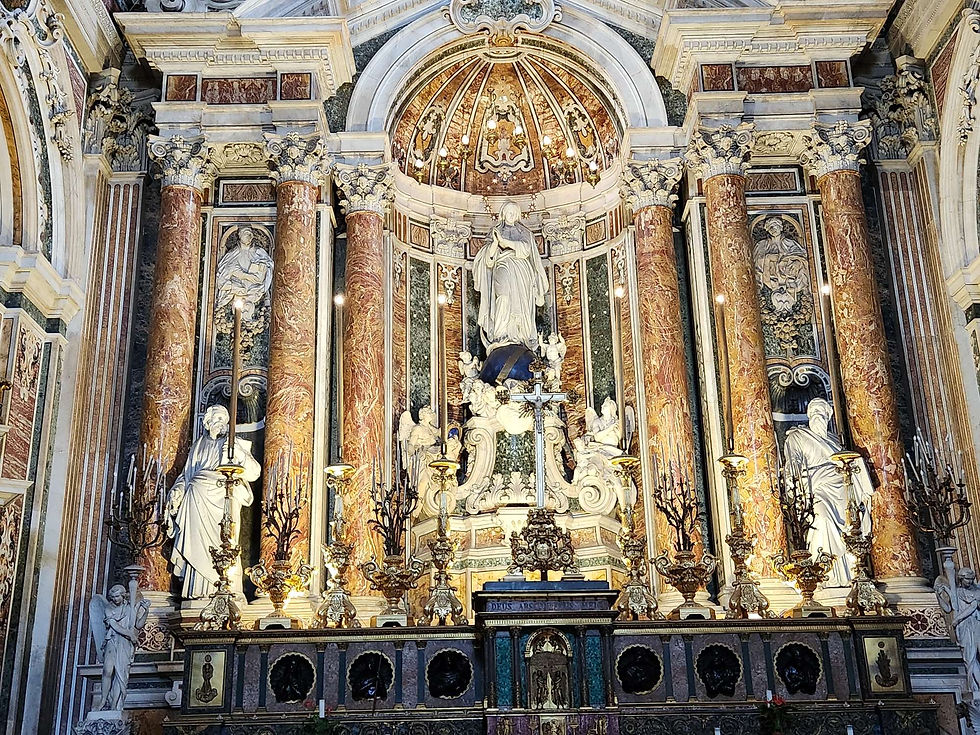
Stepping inside is like opening a treasure chest; you are immediately surrounded by overwhelming opulence, featuring polychrome marble walls and elaborate frescoes by masters such as Luca Giordano.

The interior is crowned by a stupendous dome—rebuilt after a 17th-century earthquake—that casts light on the opulent high altar, while the space is filled with meticulously carved marble structures and gilded details that embody the peak of Neapolitan Baroque splendor.

We completed our day of exploration in the elegant Chiaia district, diving into the local version of Art Nouveau known as Stile Liberty. Naples surprises with its architectural gems, and we found a stunning example on Via Gaetano Filangieri, where we paused to photograph the famous, elliptical staircase inside the Palazzo Mannajuolo. Designed by Giulio Ulisse Arata between 1909 and 1911, this masterpiece features a breathtaking helical marble structure with wrought-iron railings that seems to twist into the sky. Peeking inside from the courtyard to catch the light filtering down was the perfect end to our architectural tour of Naples.

From the regal halls of the Museo di Capodimonte to the intricate, sun-drenched mosaics of the Santa Chiara Complex and the stunning Baroque facade of Gesu Nuova Church, our second day in Naples was a whirlwind of artistic immersion. We blended deep history with urban discovery, hunting down the dazzling Stile Liberty staircase of Palazzo Mannajuolo and wandering through the atmospheric, photo-worthy streets of Via Stendhal, Vico Lungodel Gelso, and Vico D'Afflitto. As the sun set, it was clear that Naples isn't just a place you see—it's a vibrant, gritty, and beautiful city that you live, breathe, and photograph at every turn. This was truly an unforgettable day of Naples exploration, leaving us excited to see what the next chapter of this Southern Italy adventure brings.


Comments